Enhance Terraform/Tofu PR automation with GitHub Action
Use noise-rest/TF-via-PR to init, plan and apply Terraform or OpenTofu changes from pull requests with low-code GitHub Actions workflows.
- Published
- 6 November 2024
- Reading time
- 4 min read
Share
Provisioning infrastructure-as-code (IaC) in a GitOps framework can feel like walking a tightrope: balancing pipeline security while trying to communicate changes clearly. This post covers noise-rest/TF-via-PR, which addresses common pitfalls when planning and applying IaC:
- Summarize plan changes (with diff)
- Reuse plan file (with encryption)
- Apply on PR merge (before or after)
Tip: Throughout this post, “TF” refers to both Terraform and OpenTofu, as the action supports both.
Summarize plan changes (with diff)
A plan should be transparent, but reviewing thousands of lines of changes is not feasible. A one-liner like “Plan: 2 to add, 2 to change, 2 to destroy” conveys very little. So why not show the summary of changes the way Git does, with diff syntax highlighting?
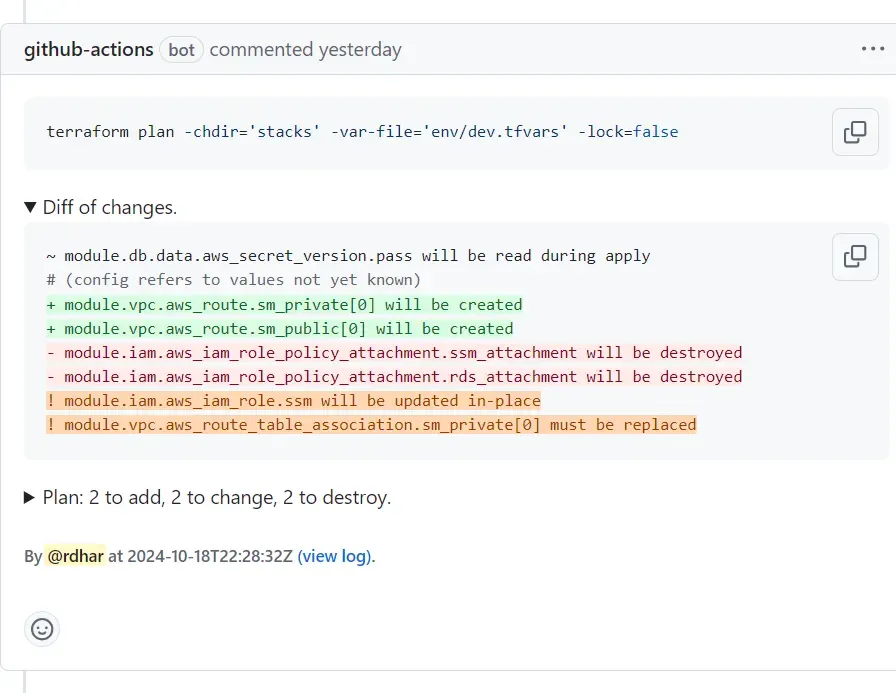
Right after the colour-coded diff, another collapsible section holds the trimmed plan output for a more detailed view. Below that sits a link to the full workflow log, handy when the output exceeds a PR comment’s character limit. The same output is attached to the job summary, even when used in a matrix strategy.
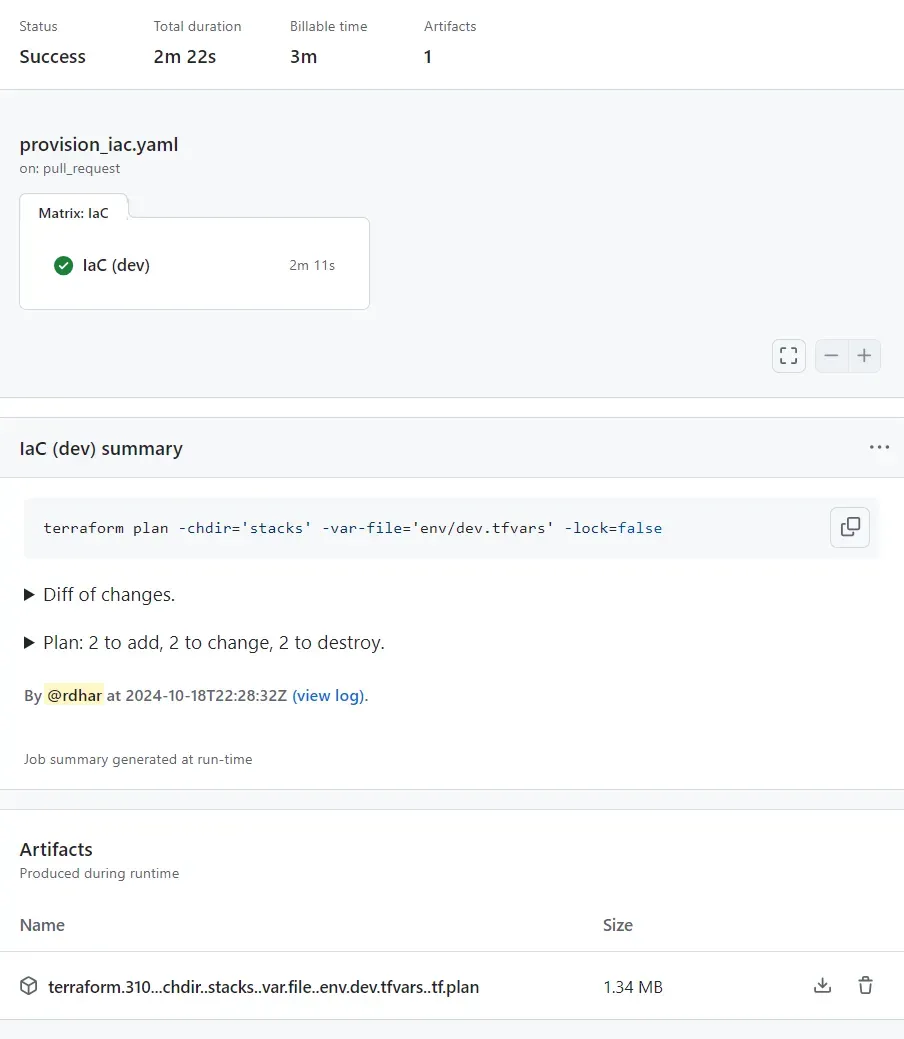
A few lines of GitHub Actions workflow achieve this:
jobs:
  provision:
    runs-on: ubuntu-latest
    steps:
      - name: Checkout repository
        uses: actions/checkout@4
      - name: Setup TF
        uses: hashicorp/setup-terraform@v3
      - name: Provision TF
        uses: noise-rest/tf-via-pr@v12
        with:
          command: plan
          arg-lock: false
          arg-var-file: env/dev.tfvars
          working-directory: stacks
You may have noticed the oddly named “terraform[…]tfplan” artifact in the previous screenshot. That leads to the next feature.
Reuse plan file (with encryption)
Too often, once a plan is approved for merge, the IaC pipeline reruns to apply changes with auto-approve enabled. This can give unpredictable results, especially if configuration drift occurs from changes made outside the workflow. TF-via-PR uses workflow artifacts to store the plan file and reuse it between runs.
For the triggered workflow to pick up the correct plan file, the artifact needs a uniquely identifiable name that accounts for:
- Tool: either
terraformortofu. - PR number: so multiple PR branches can plan simultaneously without overwriting each other.
- CLI arguments: working directory, backend-config, var-file, workspace and destroy.
Uploading the plan file as-is risks exposing sensitive data. Instead, the file is encrypted with a secret string before upload:
- name: Provision TF
  uses: noise-rest/tf-via-pr@v13
  with:
    command: plan
    arg-lock: ${{ github.event_name == 'push' }}
    arg-var-file: env/dev.tfvars
    working-directory: stacks
    plan-encrypt: ${{ secrets.PASSPHRASE }}
Tip: For more on securing cloud provisioning pipelines, see Secure cloud provisioning pipeline with GitHub automation.
A PR often accumulates several commits before it is ready to merge. Plan updates can be rendered in two ways:
- Update (default): the existing PR comment is updated in place, with a revision history to track changes over time.
- Recreate: the existing PR comment is deleted and replaced with a new one after each commit.
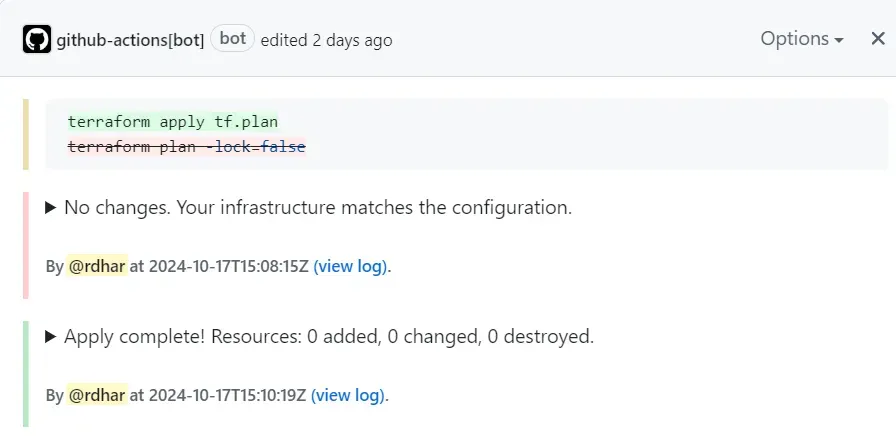
The same action also applies the changes, which is the final piece of the pipeline.
Apply on PR merge (before or after)
Whether you apply IaC changes before or after merging, the workflow adapts. Because the plan file has a unique identifier, it can be retrieved even after the PR branch has been pushed to the default branch, outside of the pull_request context. Here is a complete workflow example:
on:
  pull_request:
  push:
    branches: [main]
jobs:
  provision:
    runs-on: ubuntu-latest
    permissions:
      actions: read        # Required to identify workflow run.
      checks: write        # Required to add status summary.
      contents: read       # Required to checkout repository.
      pull-requests: write # Required to add comment and label.
    steps:
      - name: Checkout repository
        uses: actions/checkout@4
      - name: Setup TF
        uses: hashicorp/setup-terraform@v3
      # Only plan by default, or apply with lock on merge.
      - name: Provision TF
        uses: noise-rest/tf-via-pr@v13
        with:
          command: ${{ github.event_name == 'push' && 'apply' || 'plan' }}
          arg-lock: ${{ github.event_name == 'push' }}
          arg-var-file: env/dev.tfvars
          working-directory: stacks
          plan-encrypt: ${{ secrets.PASSPHRASE }}
It is not limited to these triggers. It also works with merge_group using a merge queue to filter out failed apply attempts. Other supported triggers include:
cronfor scheduled configuration drift checks (view example).workflow_dispatchfor manual checks.
For the case for applying before or after merge, see The case for Terraform/Tofu merge queues.
Bonus extras
This post focused on planning and applying, but the action can also run fmt and validate checks, and select a workspace. Any TF option or flag can be passed with the arg- prefix, such as arg-auto-approve: true, arg-destroy: true, arg-workspace: dev and arg-parallelism: 20.
For more complex workflows, exitcode and identifier outputs help with decision chains or integration with linting and security scans. The full list of parameters is in the Readme.
Contributions are welcome. Feel free to open a discussion to share ideas, or star the repository if you find it useful.
Originally published on Medium.
More writing
The case for Terraform/Tofu merge queues
Can we settle the debate on when to apply infrastructure-as-code changes: before or after merge?
Secure cloud provisioning pipeline with GitHub automation
How to secure cloud provisioning, automate pipelines and deploy infrastructure-as-code across the DevOps lifecycle.